Vol. I · No. 3 The Closed File FOIA Paper
He Didn’t JumpThe Marion Zioncheck Archive
Seattle, Washington 28 July 2026 · FOIA edition 5 U.S.C. § 552 views downloads

Editorial · Citing Aziel, 28 July 2026

This is not freedom of information

A time-volume door. A cost door. Both leave the file on the institution’s side of the desk.

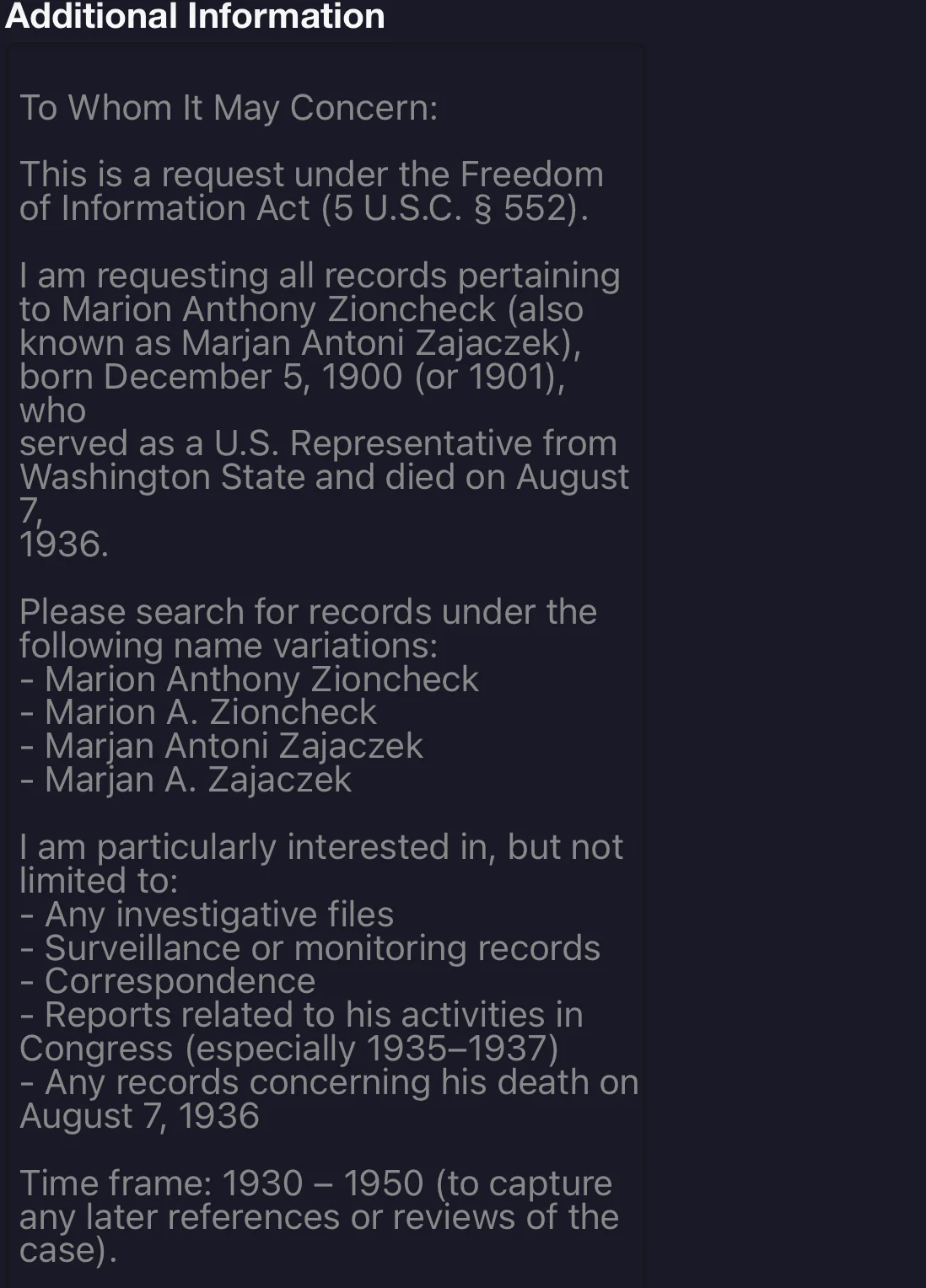
Aziel’s paper of 28 July 2026, Acknowledgement of Structural Failure in FOIA Practice, records the Freedom of Information Act as a statutory right that operational practice converts into controlled disclosure.

The paper’s subtitle names the mechanism: the time-volume / cost binary as controlled access. Two pathways, one retained file.

Mode 1 — the clock and the volume. Process the request under severe time and volume constraints and the agency denies or releases the absolute minimum that exemption language will cover. The statutory twenty working days in 5 U.S.C. § 552, with “unusual circumstances” and a further ten days, become a control surface. Volume is converted into a defense.

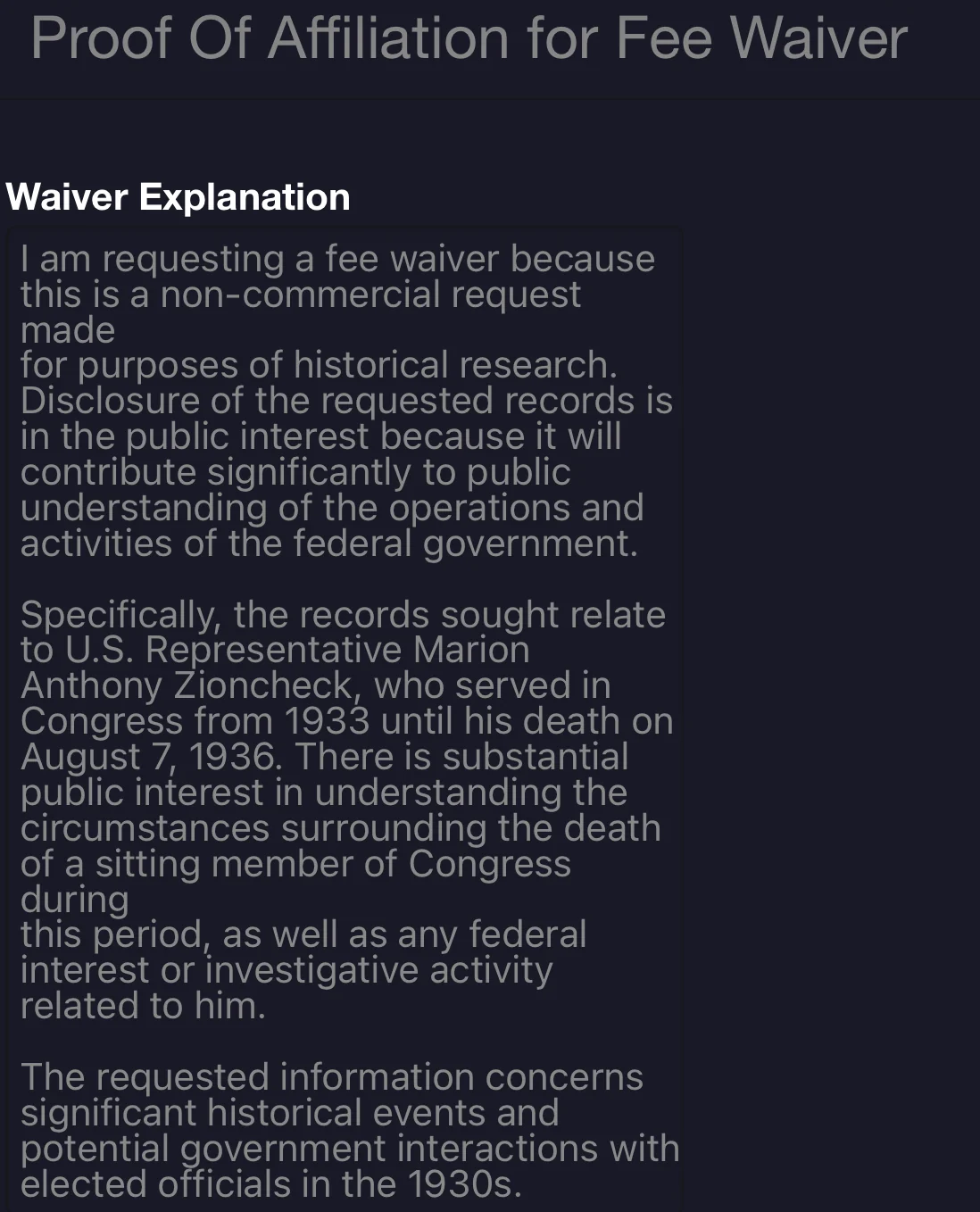
Mode 2 — the fee. Allow the request to expand and the agency shifts search, review, and duplication cost onto the requester until the request is financially prohibitive. The public-interest waiver exists in the text. It is not the default in the room.

Either outcome, the paper states, leaves the information under institutional control. Neither outcome constitutes freedom of information. The binary is not a rhetorical device. It is the practical operating surface of the statute as implemented.

The original author PDF was not present in this environment. A site citation transcript of the supplied page-1 arguments and the author’s summary is filed at /assets/foia-binary-acknowledgement.pdf. The statute as published by the government remains at foia.gov.
The Nadeau file · From the volumes

William Nadeau in the doorway

The archive names William Nadeau, Rubye’s brother-in-law, as the primary eyewitness of the official office account. Captions below cite the volume pages. No names are added that the volumes do not use.

Volume IV · Chapter 8

Contradictory statements and the staged photograph

Volume IV page analyzing William Nadeau’s contradictory statements and the death-scene photograph
Volume IV, PDF p. 11 Chapter 8 as preserved in the physics volume · Open in the reader

Volume IV states that William Nadeau provided the primary eyewitness account for the official narrative and that his statements contain multiple irreconcilable physical contradictions. It records his claims that he was standing only “one foot away,” that Zioncheck “ran around the desk,” “brushed past” him, and “dove headfirst” through the open window, and that Zioncheck went through the window in one fluid motion without waiting to see if it was open.

The same chapter examines the official death-scene photograph (WSU Libraries Digital Collections). Volume IV’s key observations: Nadeau stands in the doorway looking directly at the camera, his expression notably calm and composed, with no visible distress, shock, or grief; Zioncheck’s hat and coat are already laid out on the floor in a dramatic arrangement, contradicting accounts that Nadeau was “reaching for the hat” when Zioncheck suddenly jumped; the photo has the appearance of being taken after the fact for press purposes; and Nadeau was Rubye Nix Zioncheck’s brother-in-law.

Volume IV concludes that the image suggests the scene was managed for public consumption rather than documented in the immediate aftermath of a traumatic event.

Read Chapter 8 · Volume IV, PDF p. 11 ↗

Volume IV · Chapters 2–6

One foot away, 2.7 to 3.8 seconds

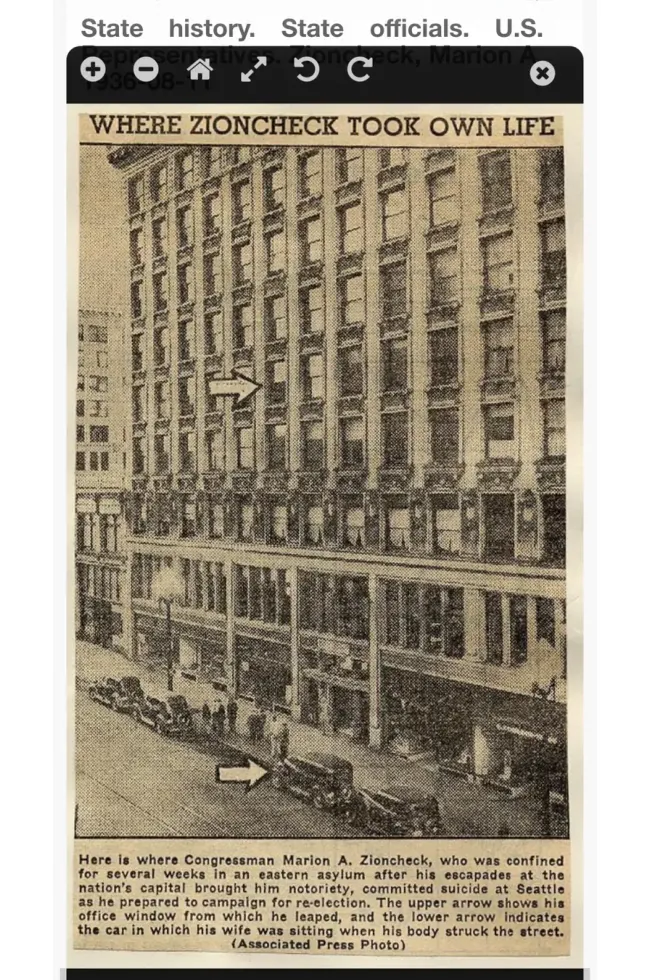
Archive plate of a press photograph of the Arctic Building with arrows marking a window and the street
Arctic Building, press plate As preserved in Volume I, PDF p. 17 · Open in the reader

Volume IV places Nadeau’s proximity claim against a calculated movement timeline. The minimum realistic time it assigns to the described sequence — initiation, run with direction change, posture transition, and launch — is 2.7–3.8+ seconds in a cluttered fifth-floor office. In that interval, the volume argues, even moderate reaction time places a person in immediate physical-contact range well before Zioncheck could reach the window and execute the required posture drop through a 27–33 inch sash opening.

Chapter 6 repeats the cornerstone claim: Nadeau said he was standing only one foot away and “missed him by a foot.” Volume IV calls that claim irreconcilable with the documented constraints.

Official narrative vs. physical reality · Volume IV, PDF p. 5 ↗

The 1-foot proximity contradiction · Volume IV, PDF p. 8 ↗

Volume V · Vic and the sequence

Nadeau in Vic’s account

Volume V page on Vic’s archival erasure and the statement that Vic knew William Nadeau personally
Volume V, PDF p. 5 Vic’s erasure chapter · Open in the reader

Volume V identifies Vic (Victor Anthony / Antoni Zajaczek, maternal cousin) as the unplanned witness who, in its account, saw the body being positioned while leaving the Alaskan Cigar Store late on August 7, 1936. The chapter states that he knew William Nadeau personally, was threatened on the spot, and stayed silent. It then lists a complete archival void after that date: no marriage record, death certificate, obituary, census entry, business records, or further newspaper or directory mentions.

The same volume’s named-participants chapter describes William Nadeau as brother-in-law: helped move the body, silenced Rubye, sold the false narrative, with an account that Volume IV treats as physically contradictory.

The two-building discussion remains on the main paper: Vic’s workplace in the old Arctic Club / Morrison Hotel; Marion’s office in the newer Arctic Building.

Two Arctic buildings, on the main paper ↗

Hat, coat, and the writing account

What the floor was said to hold

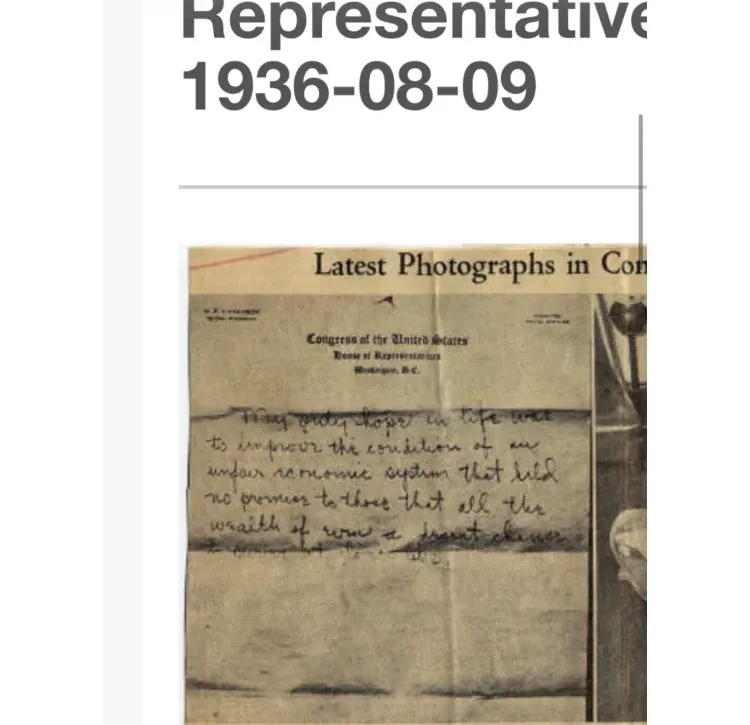
Archive plate of the photographed handwritten note on House of Representatives stationery
Photographed note Volume II, PDF p. 13 · Open in the reader

Volume IV compares the photographed placement of Marion’s hat and coat on the floor with the account of Nadeau reaching for the hat as Marion moved toward the window. Volume I is cited on the main paper for the writing account: Nadeau found Marion writing shortly before the reported jump.

Those plates belong beside one another. They are not replaced here with a doorway photograph the supplied volumes do not reproduce as a standalone image. The WSU death-scene photograph is discussed in Volume IV; the facsimile above is the volume’s own chapter page.

Writing account · Volume I, PDF p. 18 ↗

Public record · Hash-chained receipts

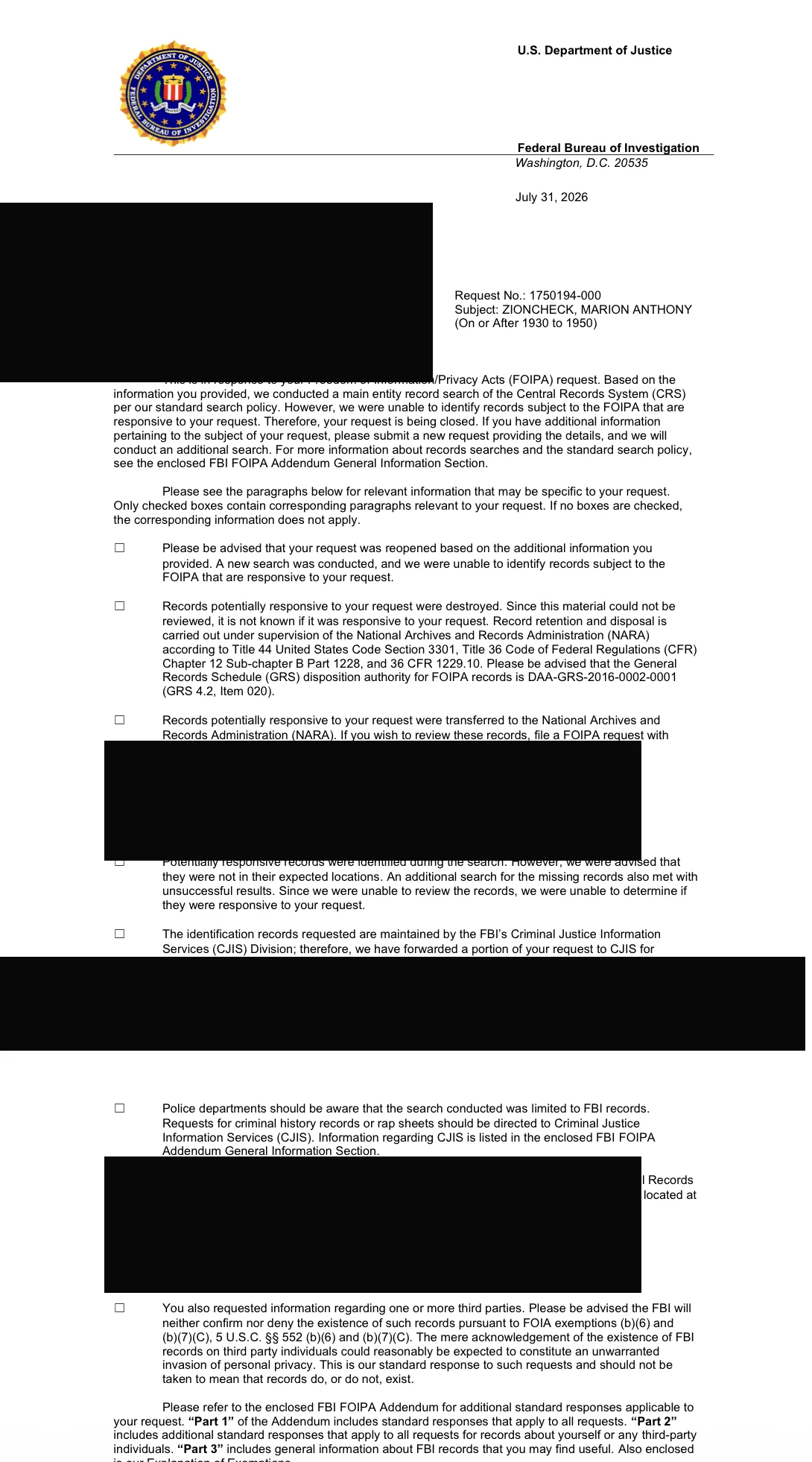
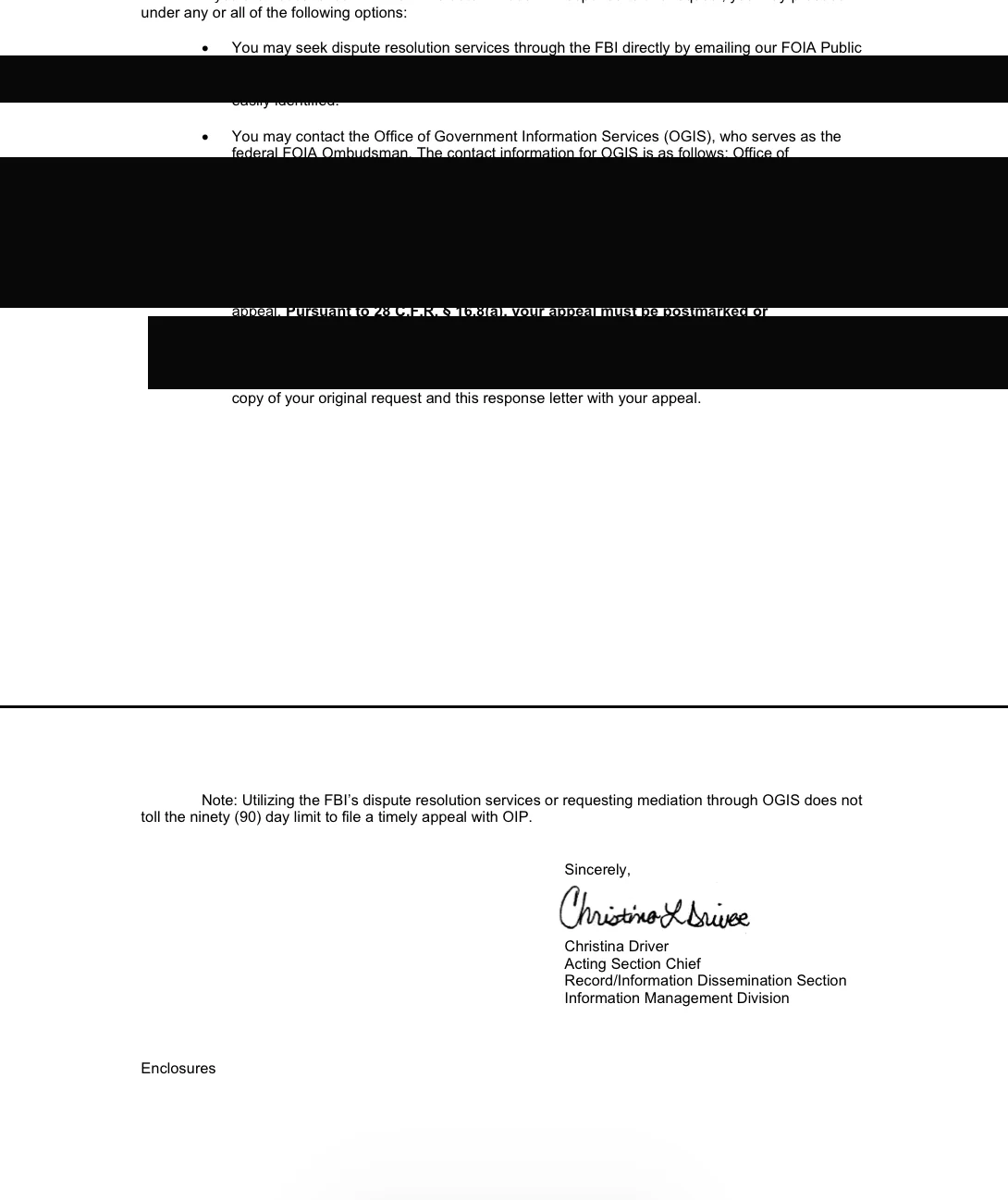
Indexed Zioncheck FOIA denials

Running count: 0. Only files that pass the Zioncheck-FOIA-denial gate are chained. Unrelated uploads are rejected with reasons and never stored on the public ledger.

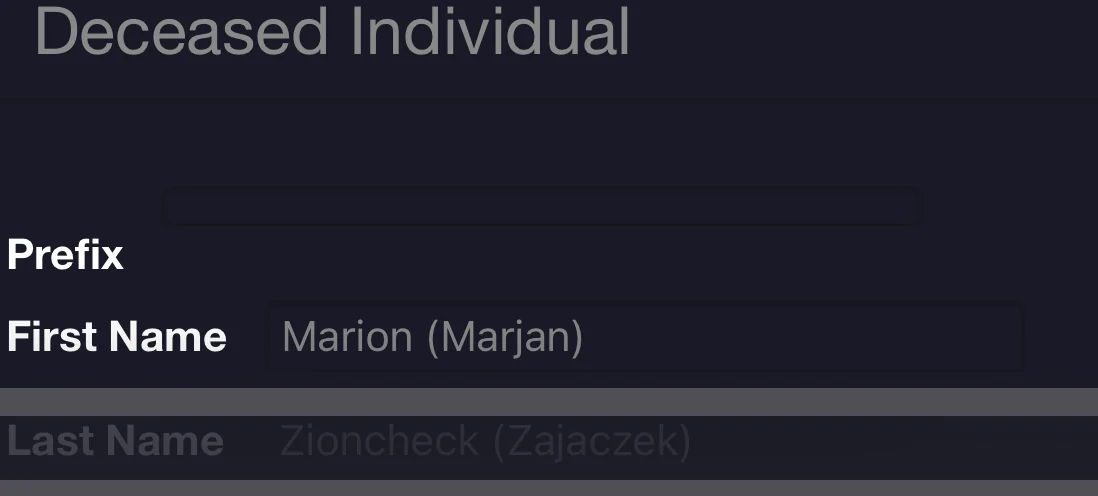
Submit a Denied FOIA regarding Zioncheck only

PDF or a readable scan. Maximum 8 MB. The Worker requires readable FOIA language, Marion Zioncheck language, and denial / withhold / exemption language. Memes, vacation photos, and other agencies’ letters are refused.

No denials have been accepted into the chain yet.